Getting Started with PVYai Agent
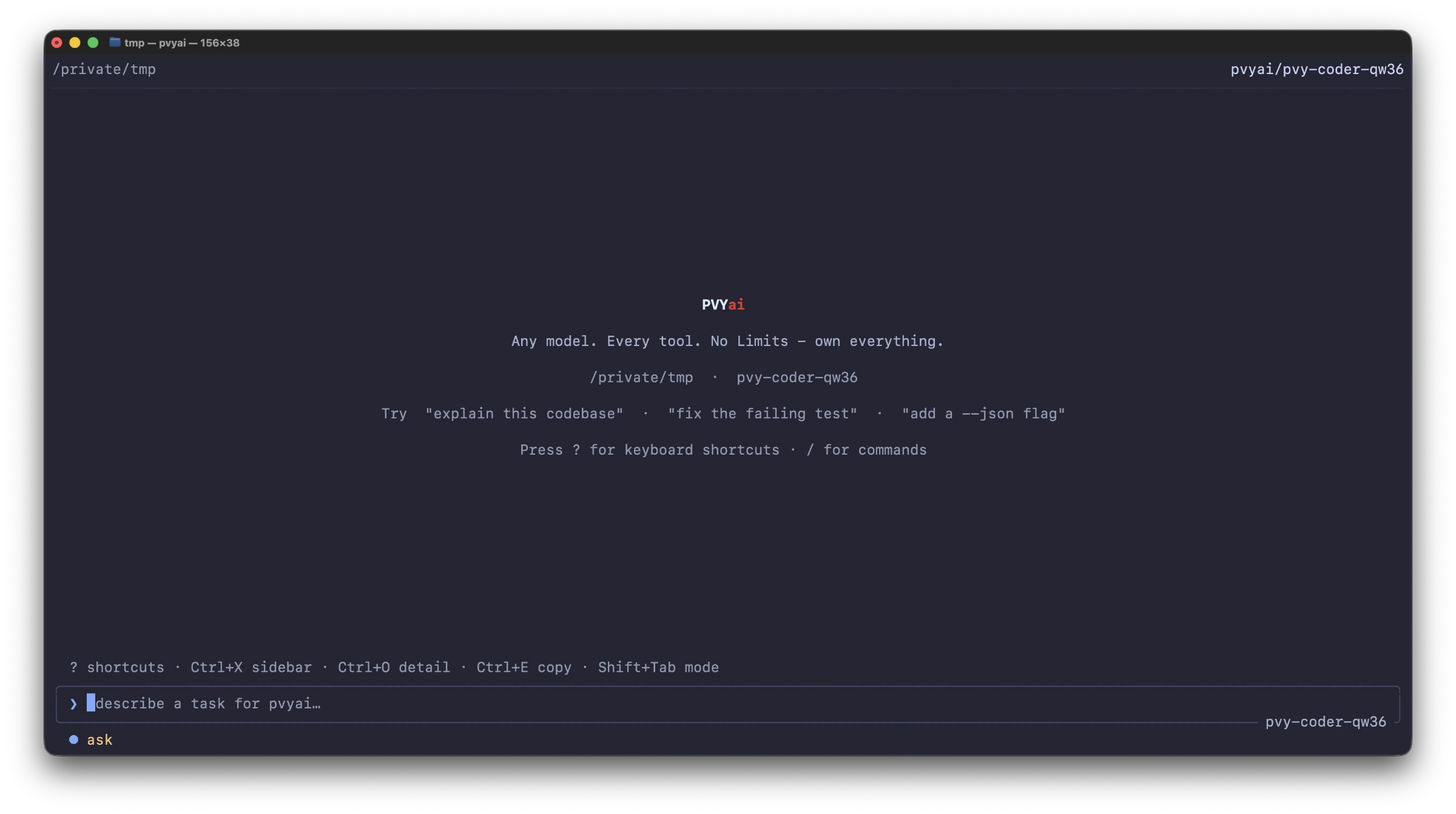
PVYai Agent is a terminal-based AI coding assistant — a Go binary that runs in your shell, reads and writes your codebase, executes commands, and manages multi-agent workflows. It supports 28+ model providers, OAuth login, skills, specialists, swarms, and plan-driven development.
Config note: The binary is
pvyai; config lives under~/.config/pvyai/and.pvyai/in your project.
¶ Installation
¶ Via npm (recommended)
npm install -g @pvyswiss/pvyai
This installs the pvyai binary and a Node.js wrapper that auto-downloads the platform-specific binary on first run.
pvyai --version
¶ As Developer with Multiple Node.js on System
As a Developer you have probably more than one Node.js on your System, and using NVE Manager to switch between them.
nvm install 24
nvm use 24
npm install -g @pvyswiss/pvyai-agent
If you are on macOS, you probably want to use brew
¶ Via direct download
Download the latest release from https://github.com/pvyswiss/pvyai-coding-agent/releases and place the binary on your PATH:
# macOS (Apple Silicon)
curl -L https://github.com/pvyswiss/pvyai-coding-agent/releases/latest/download/pvyai-v0.x.x-macos-arm64.tar.gz | tar xz
sudo mv pvyai /usr/local/bin/

# Linux x86_64
curl -L https://github.com/pvyswiss/pvyai-coding-agent/releases/latest/download/pvyai-v0.x.x-linux-x64.tar.gz | tar xz
sudo mv pvyai /usr/local/bin/
¶ Verify installation
pvyai --version
pvyai --help
¶ First-Run Setup
¶ Launch the interactive shell
cd your-project
pvyai
if you run a developer Version: ./pvai
On first launch with no provider configured, PVYai drops into the provider wizard — a guided setup flow that walks you through choosing a model provider.
¶ The Provider Wizard
The wizard has two entry paths:
| Method | Description | Providers |
|---|---|---|
| Sign in with OAuth | One-click browser login, no API key needed | OpenRouter, xAI, ChatGPT, Hugging Face |
| Paste an API key | Manual API key entry for any of 28+ providers | All providers |
¶ Quick start: PVY.ai Platform (recommended default)
PVY.ai Platform is the recommended provider — it’s the PVY Swiss sovereign AI endpoint.
Simply choose pre-selected PVYai Platform and paste your API Key. Done.
export PVYAI_API_KEY="your-api-key"
pvyai
The wizard detects the env var and skips credential entry. Your model defaults to qwen3.6:35b (Qwen 3.6 35B MoE, 110 tok/s on H200).
¶ Quick start: PVYai
Use the Setup Wizard, choose PVYai, Paste your PVYai API Key or if you prefer the Shell:
export PVYAI_API_KEY="YourPrivate_PVYai_sk-key"
pvyai setup pvyai --model qwen3.6:35b
pvyai
or:
export PVYAI_API_KEY="YourPrivate_PVYai_sk-key"
pvyai setup pvyai --model pvy-architect
pvyai
¶ Quick start: OpenAI
export OPENAI_API_KEY="sk-..."
pvyai
¶ Quick start: Anthropic
export ANTHROPIC_API_KEY="sk-ant-..."
pvyai
Please note: PVYai itself is offering all available Anthropic Models, through its Unified SSE API. Using Anthropic via PVYai let you benefit from:
- PVYai Sentinel
- PVYai Memory
- PVYai PriVacY
- PVYai MCP Tools with native Function Call
- PVYai Token Caching (Anthropic and PVYai Models)
¶ Quick start: OAuth (OpenRouter)
- Choose “Sign in with OAuth” in the wizard
- Select “OpenRouter or any other”
- Your browser opens to OpenRouter’s consent page
- Authorize → PVYai mints an API key automatically
- The key is stored securely (keyring on macOS, encrypted file on Linux)
We have oAuth prepared for PVY@Cloud Subscribers, which then will auto-provisioning it later automatically based on the PVY-ID. PVY@Office users have to configure the Endpoint by them self or ask support. ETA is early 2027.
¶ Headless / SSH setup (device-code flow)
If you’re on a headless server without a browser:
- Choose “Sign in with OAuth”
- Press
dto start the device-code flow - The TUI displays a URL and a user code
- On any device, visit the URL and enter the code
- PVYai polls until authorization completes
¶ Configuration
¶ Config file locations
| File | Scope | Path |
|---|---|---|
| User config | Personal, all projects | ~/.config/pvyai/config.json |
| Project config | Shared with team (checked into repo) | <project>/.pvyai/config.json |
Project config merges on top of user config. API keys are never stored in project config — they go to the encrypted credential store.
¶ Minimal config example
{
  "activeProvider": "pvyai",
  "providers": [
    {
      "name": "pvyai",
      "provider": "pvyai",
      "catalogID": "pvyai",
      "baseURL": "https://ai-api.pvy.swiss/api",
      "model": "qwen3.6:35b"
    }
  ],
  "maxTurns": 50
}
¶ Multi-provider config example
{
  "activeProvider": "pvyai",
  "providers": [
    {
      "name": "pvyai",
      "provider": "pvyai",
      "catalogID": "pvyai",
      "baseURL": "https://ai-api.pvy.swiss/api",
      "model": "qwen3.6:35b"
    },
    {
      "name": "anthropic-cloud",
      "provider": "anthropic",
      "catalogID": "anthropic",
      "model": "claude-sonnet-4.5"
    },
    {
      "name": "ollama-local",
      "provider": "ollama",
      "catalogID": "ollama",
      "baseURL": "http://192.168.188.30:11434/v1",
      "model": "qwen2.5-coder:32b"
    }
  ],
  "maxTurns": 50,
  "sandbox": {
    "mode": "enforce"
  },
  "notify": {
    "mode": "system"
  }
}
Note: For Ollama running on a remote host (not localhost), set the
baseURLexplicitly. The default Ollama descriptor useshttp://localhost:11434/v1— if you’re running the agent on your Mac but Ollama is on a server, the live model discovery will fail silently and the model picker will show nothing.
¶ Switching providers at runtime
# In the TUI:
/provider              # Opens the provider wizard
/model                 # Opens the model picker (shows models from all configured providers)
/model claude-sonnet-4.5   # Switch to a specific model (auto-resolves the provider)
/effort high           # Set reasoning effort
¶ Modes (presets)
PVYai supports built-in mode presets that bundle model + reasoning effort + turn limits:
| Mode | Model | Effort | Max Turns | Use case |
|---|---|---|---|---|
smart |
claude-sonnet-4.5 | medium | 50 (default) | General-purpose coding |
deep |
claude-opus-4.1 | high | 50 | Complex reasoning, architecture |
fast |
claude-haiku-4.5 | low | 15 | Quick edits, autocomplete |
large |
gemini-2.5-pro | medium | 50 | Long-context tasks (1M ctx) |
precise |
claude-sonnet-4.5 | high | 50 | Careful, thorough work |
# Use a mode
pvyai --mode deep "Refactor the authentication module"

# Or set it interactively
# Type: /model deep
¶ Environment Variables
¶ Provider selection
| Variable | Purpose | Example |
|---|---|---|
PVYAI_PROVIDER |
Active provider name | pvyai |
PVYAI_API_KEY |
PVY.ai Platform API key | pvyai-... |
OPENAI_API_KEY |
OpenAI API key | sk-... |
ANTHROPIC_API_KEY |
Anthropic API key | sk-ant-... |
GEMINI_API_KEY |
Google Gemini API key | AI... |
OPENROUTER_API_KEY |
OpenRouter API key | sk-or-... |
GROQ_API_KEY |
Groq API key | gsk_... |
DEEPSEEK_API_KEY |
DeepSeek API key | — |
OLLAMA_API_KEY |
Ollama Cloud API key | — |
¶ Agent behavior
| Variable | Purpose | Default |
|---|---|---|
PVYAI_MAX_TURNS |
Maximum agent turns per run | 50 (ceiling: 500) |
PVYAI_THEME |
Color theme name | dark |
PVYAI_REDUCED_MOTION |
Disable animations (accessibility) | unset |
PVYAI_NO_FADE |
Disable streaming text fade | unset |
PVYAI_STREAM_IDLE_TIMEOUT |
Stream idle watchdog timeout | 120s |
PVYAI_TOOL_OUTPUT_CEILING_TOKENS |
Max tokens per tool output | 30000 |
PVYAI_FORMAT_ON_WRITE |
Auto-format files on write | unset |
PVYAI_CHECKPOINTS |
Enable session checkpoints (on/off) |
on |
¶ Credential storage
| Variable | Purpose | Options |
|---|---|---|
PVYAI_CRED_STORAGE |
How API keys are stored | keyring (default), encrypted-file, plaintext |
PVYAI_OAUTH_STORAGE |
How OAuth tokens are stored | keyring, encrypted-file |
PVYAI_OAUTH_TOKENS_PATH |
Override OAuth token file location | — |
¶ Sandbox
| Variable | Purpose |
|---|---|
PVYAI_SANDBOXED |
Set to 1 when running inside the sandbox |
PVYAI_SANDBOX_BACKEND |
Sandbox backend (macos-seatbelt, linux-bwrap, windows-restricted-token) |
PVYAI_SANDBOX_NETWORK |
Network policy (deny, allow) |
PVYAI_SANDBOX_GRANTS_PATH |
Override sandbox grants file location |
¶ Web search
| Variable | Purpose |
|---|---|
PVYAI_WEBSEARCH_PROVIDER |
Search backend (searxng, tavily) |
PVYAI_WEBSEARCH_BASE_URL |
Search API base URL |
PVYAI_WEBSEARCH_API_KEY |
Search API key |
¶ MCP OAuth
| Variable | Purpose |
|---|---|
PVYAI_MCP_OAUTH_TOKENS_PATH |
Override MCP OAuth token file location |
PVYAI_MCP_PERMISSIONS_PATH |
Override MCP permissions file location |
¶ Directory Layout
~/.config/pvyai/
├── config.json              # User configuration
├── credentials              # Encrypted credential store
├── themes/                  # Custom theme files
├── specialists/             # User-level specialist definitions
│   ├── api-reviewer.md
│   └── test-writer.md
└── commands/                # User-level slash commands
    └── deploy.md

~/.local/share/pvyai/
├── skills/                  # Installed skills
│   ├── deploy-checks/
│   │   ├── SKILL.md
│   │   └── ...
│   └── skills.lock           # Skill provenance hashes
├── cron/                    # Cron job store
│   └── <job-id>/
│       ├── metadata.json
│       └── runs.jsonl
└── sessions/                # Session lineage store

<project>/.pvyai/
├── config.json              # Project-level config (shared with team)
├── specs/                   # Spec-mode drafts
│   └── 2026-07-07-add-review-flow.md
├── specialists/             # Project-level specialist definitions
│   └── db-migration.md
├── commands/                # Project-level slash commands
│   └── commit.md
├── swarm/                   # Swarm mailbox state
│   └── <team>/inboxes/
└── loop.md                  # Loop prompt for cron jobs
¶ CLI Overview
pvyai                                    # Interactive TUI shell (default)
pvyai exec "fix the bug in auth.go"      # One-shot prompt
pvyai exec --model claude-sonnet-4.5 "refactor auth"  # One-shot with specific model
pvyai exec --mode deep "design the API"  # One-shot with a mode preset
pvyai exec -w refactor-task "refactor X" # One-shot in an isolated git worktree
pvyai exec --file prompt.txt             # One-shot from a file

pvyai setup                               # Guided provider setup (same as TUI wizard)
pvyai auth                                # OAuth login management
pvyai auth login openrouter               # OAuth login for a specific provider
pvyai auth status                         # Show OAuth token status
pvyai auth logout openrouter              # Revoke OAuth token

pvyai providers                           # Inspect configured providers
pvyai providers check openai --connectivity  # Test provider connectivity
pvyai providers catalog                   # List all 28+ built-in providers

pvyai models                              # List model registry entries
pvyai doctor                              # Run health checks
pvyai context                             # Report context budget usage

pvyai skills list                         # List installed skills
pvyai skills add <git-url>               # Install a skill from git
pvyai skills info <name>                  # Show skill details

pvyai specialist list                     # List specialist definitions
pvyai specialist show <name>             # Show a specialist manifest
pvyai specialist create <name> --description "..." --prompt "..."  # Create

pvyai mcp list                            # List MCP server backends
pvyai mcp add <name> --url <url>          # Add an MCP server

pvyai cron add "0 9 * * *" --prompt "..."  # Schedule a recurring job
pvyai cron list                           # List scheduled jobs
pvyai cron run                            # Start the cron loop (foreground)

pvyai worktrees prepare --name refactor   # Create an isolated git worktree

pvyai eval --suite evals.json             # Validate an eval suite
pvyai eval run --suite evals.json --task <id> --workspace /tmp/ws  # Score a workspace
pvyai eval bench --suite evals.json --agent-command "pvyai exec --cwd {workspace} {prompt}"  # Full benchmark

pvyai search "authentication"            # Search persisted sessions
pvyai sessions                           # Inspect session lineage
pvyai version                            # Print version
pvyai update                             # Check for updates
¶ Matrix / PVYmessenger Notifications
PVYai supports webhook notifications via the PVYmessenger Web-hook bridge — a Slack-compatible webhook bridge for PVYmessenger. This is used by PVYmessenger via Channel Details, Bridges & Bots, add Web-hook, save and copy URL.
The bridge accepts a JSON POST with text, format ("plain" or "html"), displayName, avatarUrl, and msgtype fields. When format is "html", the text field supports minimal HTML (<b>, <i>, <br>, <a>, <code>, <pre>) rendered natively by Matrix.
¶ Setup
¶ 1. Set the webhook URL (env var — contains the bridge token)
export PVYAI_NOTIFY_WEBHOOK_URL="Paste the URL Here"
The URL contains the bridge token, so it stays in the environment — never in
config.json.
¶ 2. Optional: Set display name, avatar, and message type (env vars)
export PVYAI_NOTIFY_WEBHOOK_DISPLAY_NAME="PVYai Agent"
export PVYAI_NOTIFY_WEBHOOK_AVATAR_URL="https://ai.pvy.swiss/static/pvai-logo.png"
export PVYAI_NOTIFY_WEBHOOK_MSGTYPE="notice"    # "notice" (less intrusive) or "emote"
export PVYAI_NOTIFY_WEBHOOK_SUMMARY="pvyai-coder" # optional run summary
¶ 3. Optional: Configure HTML formatting (config.json)
{
  "notify": {
    "mode": "both",
    "focusMode": "unfocused",
    "webhook": {
      "format": "html",
      "displayName": "PVYai Agent",
      "msgtype": "notice"
    }
  }
}
The webhook URL is set via env var (contains the bridge token):
export PVYAI_NOTIFY_WEBHOOK_URL="https://our-endpoint.im/api/v1/matrix/hook/yoursuperlongtoken"
Environment variables take precedence over config.json values. The webhook URL is always from the environment (never from config.json).
¶ Example Matrix messages
Plain format (completion):
{
  "text": "PVYai: ready",
  "format": "plain",
  "displayName": "PVYai Agent",
  "type": "completion"
}
HTML format (completion with summary):
{
  "text": "<b>PVYai: ready</b><br><i>pvyai-coder</i>",
  "format": "html",
  "displayName": "PVYai Agent",
  "msgtype": "notice",
  "type": "completion",
  "summary": "pvyai-coder"
}
HTML format (awaiting input):
{
  "text": "<b>PVYai: needs input</b>",
  "format": "html",
  "displayName": "PVYai Agent",
  "msgtype": "notice",
  "type": "awaiting_input"
}
¶ Webhook env vars reference
| Variable | Purpose | Default |
|---|---|---|
PVYAI_NOTIFY_WEBHOOK_URL |
Webhook destination URL (required) | unset (disabled) |
PVYAI_NOTIFY_WEBHOOK_SUMMARY |
One-line run summary in payload | unset |
PVYAI_NOTIFY_WEBHOOK_FORMAT |
Text format: "plain" or "html" |
plain |
PVYAI_NOTIFY_WEBHOOK_DISPLAY_NAME |
Sender name shown in Matrix | unset |
PVYAI_NOTIFY_WEBHOOK_AVATAR_URL |
Sender avatar URL in Matrix | unset |
PVYAI_NOTIFY_WEBHOOK_MSGTYPE |
Matrix message type: "notice" or "emote" |
unset (normal) |
¶ Backward compatibility
Existing Slack incoming webhook users are unaffected — the new fields (format, displayName, avatarUrl, msgtype) are all omitempty and absent from the payload when unset. The text field remains the primary rendered content, exactly as before.
¶ Next Steps
- Core Workflow & TUI Reference — Learn the keyboard shortcuts, slash commands, and permission system
- Plans & Specs — Plan-driven development with
update_planand/spec - Model selections & Providers — Deep dive into providers, the model picker, and the coding-model filter